
Let’s Lay It on the Line! United Airlines Corporate Culture Failed!

Corporate Culture drives customer service and this story is a great example. By now, if you aren’t hiding in a cave, you have likely seen the video of a United Airlines customer being dragged down the aisle by Chicago Police. If you haven’t, you view it here.

United Airlines Passenger Removed Forcibly

picture of broken guitarIf you are not outraged, you should be. And this is just one of the many errors in judgement that has created problems for United.

  • Do you remember “GuitarGate“? United insists on checking a performer’s expensive guitar-  the one he makes a living with – and damages it while loading.
  • How about when United threw an girl with Autism Spectrum Disorder and her family off the plane?
  • At another time United removes a passenger from the boarding list because she complained about the bad service.

And there are other incidents documented out on the Internet, but you get the idea.

Operational Excellence is NOT a Corporate Culture

According to story by NPR in 2015, United had one of the worst records of customer satisfaction, poor record of on-time performance, and other issues; making it the lower tier of the airline industry. More recent studies show slight improvement but still rank United near the bottom.

United has struggled with that image for years. In an effort to become more profitable, United placed “operational excellence” as their high priority, shrugging off concerns of customer service in favor of cost-cutting and efficiency.

No Service, No Excellence

And now they not only have poor customer service standards, but it seems that excellence is eluding them as well.

See, operational excellence may be a strategy for running an organization but it can’t be the only one. It certainly can’t be the high priority. More so, operational excellence cannot be the driver for the culture of the organization.

And at United Airlines, it apparently is.

A Corporate Culture of Re-Accommodating

Following the hoopla over this latest episode of dragging the doctor off the plane, United Airlines CEO Oscar Munoz issued the following statement:

“This is an upsetting event to all of us here at United. I apologize for having to re-accommodate these customers. Our team is moving with a sense of urgency to work with the authorities and conduct our own detailed review of what happened.”

I didn’t even know re-accommodate was a word, but let’s not go there. It’s not so much what Munoz said as what he didn’t say. He didn’t say “this is not the way we do business here!” or “I apologize to David Dao and we will do whatever is necessary to make it right”.

In fact, what Munoz did allegedly do was send a letter to the employees on Sunday praising them for how they handled the situation and for following operational procedures.

In doing so, Munoz reinforced that employees are not to think but simply follow operational parameters even to the extreme.

Lack of Empowerment

Travel Blogger Patrick Smith on his blog Ask the Pilot says it is a prime example of the lack of empowerment in the airline industry as a whole, not just at United. He makes the point that in the case of David Dao it never should have come to the point of dragging him off the plane. There had to be a better solution and yet no one bothered to figure it out.

Why?

Smith essentially says it’s because the United Airlines corporate culture doesn’t support it. The culture emphasizes following procedure over finding solutions. Have you ever had a boss essentially tell you that you were not paid to think or make decisions? I believe (and I think Patrick Smith agrees with me) that is what is happening here.

Let’s Empower You

What should United have done instead? In what ways could this have been avoided? What are your corporate culture war stories?

Share your thoughts here or email me at psimkins@BoldlyLead.com


The Employee Engagement Survey Says….

The Employee Engagement Survey is likely the biggest FAIL in our efforts to bring people back into workforce activity.

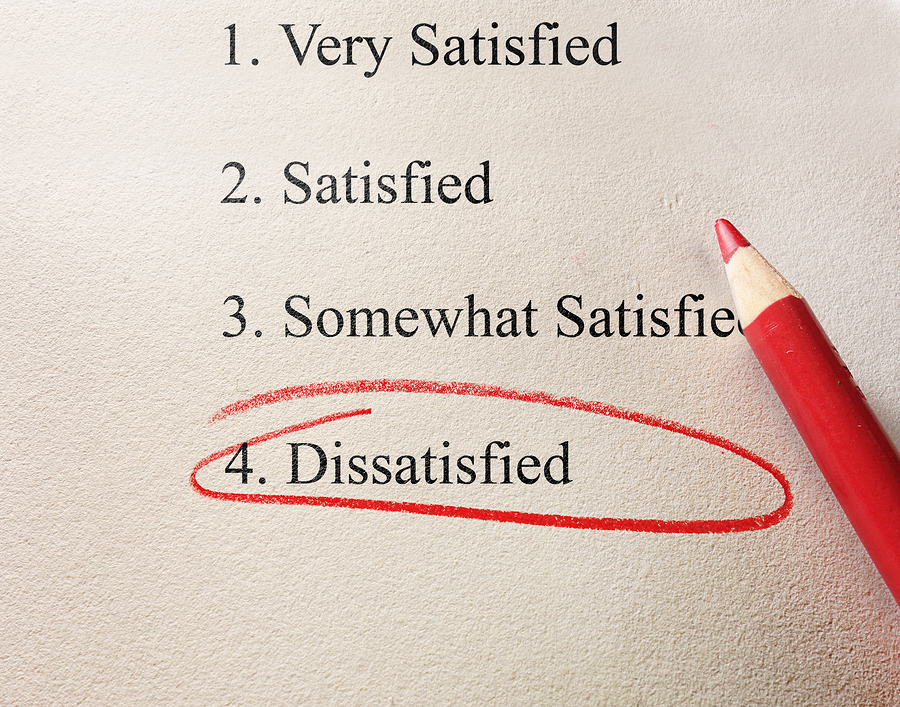
Dissatisfied survey with red circle and pencil on textured paperIf you want evidence of this, simply look at the survey numbers. According to the 2016 Gallup Employee Engagement Report, the most any particular industry has risen in employee engagement in four years is only four points. Note that those numbers were pretty low to begin with. So we haven’t exactly made leaps and bounds.

Same Song, Different Title

The Annual Employee Engagement Survey is really just a new name for an old system. For years it was called the Annual Employee Satisfaction Survey. It was typically only done at large enterprise organizations. Siemens, Lockheed Martin, and countless others would produce a survey every December. They would then spend so much time compiling the feedback; guaranteeing that the results were dated and no longer valid. At that point they do it all over again.

What’s the old adage about insanity?

Isn’t it doing the same thing over and over again and expecting different results?

The outcome is that the newly named survey gets the same results as it did before.

Think about it. Have you ever really had a company announce a positive initiative based on last month’s employee survey? If you did, it was likely a small company.

Here are some reasons Annual Employee Engagement Surveys don’t work:

  1. The word ANNUAL

    Determining where your employee engagement stands cannot be successful if only done once a year. It’s hard to be agile when your measurement of progress and direction is so infrequent. What if you conducted a survey quarterly instead of annually? How about monthly?

  2. They ask the wrong questions

    Typical questions asked on the survey are things like “Are you happy in your work?”, “How do you rate your supervisor?”, “What’s the one thing you would change about your job?”, “Do you think you have a future here?”

    The first question is irrelevant because happiness is not your job. An employee can be unhappy and still be engaged. It’s better when they are happy AND engaged, but that’s their choice and not a factor you can affect.

    The second question is usually given using a scale of some sort. What makes it useless is that one person’s 7 is another person’s nine or five. Unless very well defined criteria is given, scales aren’t very useful.

    The third question is limiting on the one hand and ambiguous on the other. It allows for too many different answers; making it hard to get a consensus and also most answers can’t be implemented. Better to ask about specific initiatives that are already in the works or in place.

    The fourth question is not really applicable anymore, particularly with Millennials in the workplace. In general, they can’t imagine a long-term future anywhere, good or bad. With few exceptions, the days of long-term, single-company employment are over. Why ask about it?

  3. They ask the wrong people

    Most surveys are voluntary; heaven help you if it isn’t. Most of the people who voluntarily take engagement surveys are the ones who are already engaged. The disengaged – the ones you hope to actually learn something about – are not very open to taking a survey, because they don’t believe anything positive will come out of it. Think about ways to directly reach the disengaged – I guarantee you it won’t be through a survey. It requires a personal touch.

  4. They are not trusted

    We are going to use the results of this survey to improve the work environment.
        “Yeah, sure!”

    You will be totally anonymous on this survey. No one will know what results you submitted.
        “Ri-i-i-i-i-i-i-ght!”

    A whopping 80% of employees, according to one study, do not believe there will actually be a positive outcome to an employee engagement survey.In addition, they don’t believe they will actually remain anonymous and believe they may face repercussions from their responses. Usually, they are right on both counts.

    As a trainer, I have asked hundreds of groups to complete course evaluation surveys for me. I read every one of them, usually immediately after the class. I can look through them and identify exactly who completed it based on responses and my memory of their attitude and behavior.

    If trust does not exist to begin with, the survey will not improve it; in fact, it will break it down even farther.

  5. No real commitment from executive level management

    The upper management is willing to put out a survey but not willing to dedicate themselves to taking action. They would rather wait and see what the responses are. From that point they either say “that’s nice” or “what should we do now?” That leads to the last reason.

  6. There is no action plan

    When there is no commitment there is no plan. For a survey to be effective, you must have a pre-determined plan of how to analyze the responses and act upon the results. Too many times we spend a lot of time and money creating the survey but very little for making it productive for our organization. What good is it to know about a problem if we have no idea what we are going to do about it? It’s money thrown to the wind.

Step up and Boldly Lead

Most organizations are implementing or allowing some sort of social media now. Microsoft Office 365 has a social media feature in it. Many organizations are using SharePoint. It’s possible to create private social media pages for your company or initiative.  What if you used that medium for reaching your employees in a more real-time manner?

How about a question of the week? Ask about their opinion on a very specific project or service for employees; no more than 2-3 questions. It’s quick and easy, it’s engaging, and it’s actionable.

Throw the surveys out. Step up and Boldly Lead. Gauge your employee engagement by being more engaging.

[tweetthis]Gauge your employee engagement by being more engaging.[/tweetthis]

How have you see surveys work (or not work) in the past? What’s the funniest or dumbest question you have ever seen on a survey? Share your thoughts here or email me at psimkins@BoldlyLead.com.